




EnviroViroSeq: Advanced HTS and AI-powered Analysis of Viromes in Hops and the Environment
Basic research project: ARIS J4-70162
Project leader: dr. Tanja Guček

High-throughput sequencing (HTS) has significantly transformed research in recent years, as rapidly decreasing costs and advances in data analysis have enabled the exploration of entire viromes, including previously unknown viruses and viroids. With the development of HTS, more than 2,100 species of plant viruses have been identified. Due to their parasitic nature, high transmissibility, and adaptability, plant pathogenic viruses account for approximately half of all newly emerging plant diseases, causing losses equivalent to about one quarter of the expected crop yield. HTS has great potential for hop research, as hops are often infected by numerous viruses and viroids due to their susceptibility, and HTS enables their detection and a better understanding of viral communities.
In this context, the project “EnviroViroSeq: Advanced HTS Analysis of Viromes in Hops and the Environment Supported by Artificial Intelligence” aims to investigate and improve the understanding of viromes in selected agroecosystems, with a particular focus on hops, an economically important crop in Slovenia. The project will conduct a comprehensive analysis of the virome of hops, surrounding plants, and irrigation water in order to improve the understanding of the role of these pathogens in hop health and production. The research will also focus on identifying potential reservoirs of these pathogens, such as weeds and wild hops, and on assessing how environmental factors, including irrigation practices, may influence their spread. The EnviroViroSeq project will utilize innovative technologies and methodologies, such as HTS platforms and artificial intelligence (AI), to better understand the viruses and viroids present in these agroecosystems, their interactions with host plants, and their broader ecological impacts. The study will also examine the environmental impact of these pathogens, which is crucial for predicting the emergence of new viral threats in agriculture.
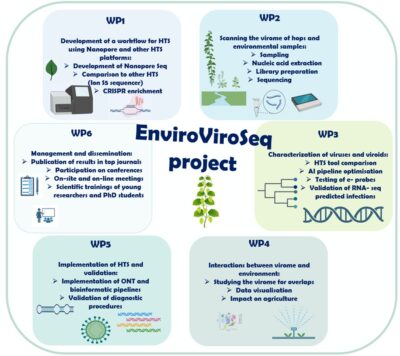
The EnviroViroSeq project consists of six work packages. Work Package 6 is dedicated to project management and dissemination of results, while the remaining five include: (1) development of a HTS workflow using Nanopore technology and other HTS platforms, as well as the development of CRISPR-based methods for multi-pathogen detection; (2) screening of the virome of hops and environmental samples (irrigation water, weeds, and wild hops) to study the diversity and occurrence of viruses and viroids; (3) characterization of viruses and viroids and the discovery of novel viruses using advanced HTS data analysis approaches, with confirmation by ELISA, RT-PCR, and Sanger sequencing; (4) investigation of interactions between the virome and the environment through analysis of virome overlap, as well as phylogenetic and visualization analyses; and (5) implementation and validation of Nanopore based diagnostic procedures at IHPS as a reliable diagnostic tool for the detection of plant viruses in accordance with EPPO guidelines.
The project will be led by the Institute for Hop Research and Brewing of Slovenia (SIHRB), in close collaboration with the Biotechnical Faculty (BF) and The Jožef Stefan Institute (IJS). The ultimate goal of the project is to develop reliable, efficient, and scalable diagnostic tools for plant viral diseases. The application of Nanopore technology, optimized in accordance with international standards, will provide a robust framework for routine pathogen screening. This research will not only advance scientific knowledge but also help improve agricultural practices, biosecurity, and disease management strategies, contributing to the resilience and sustainability of global agriculture.
Funding period: 01.03.2026- 28.02.2029
Funded hours: 2545 hours annually
- WP1: Development of a workflow for HTS using Nanopore and other HTS platforms
- WP2: Scanning the virome of hops and environmental samples
- WP3: Characterization of viruses and viroids
- WP4: Interactions between virome and environment
- WP5: Implementation and validation of HTS-based diagnostic procedures
- WP6: Management and dissemination
In preparation.