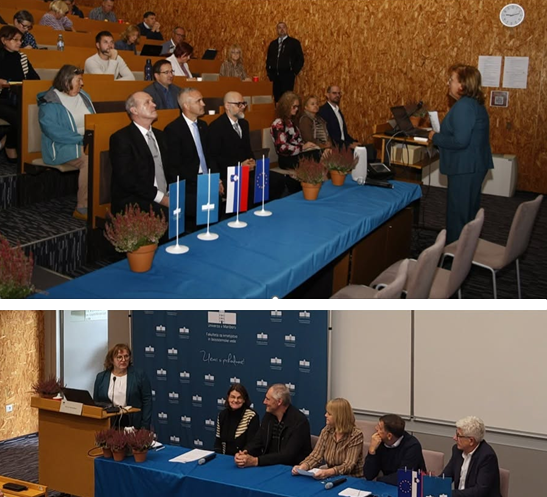

The conference, organised by the Faculty of Agriculture and Life Sciences, opened with welcoming addresses by Minister of Agriculture Janez Cigler Kralj, the Rector of the University of Maribor, Prof. Dr Dean Korošak, and the conference’s lead organiser, Prof. Dr Martina Bavec. The Minister emphasised the importance of strengthening domestic organic production and increasing the share of organic food served in kindergartens, schools and hospitals. In 2025, Slovenia had 4,033 agricultural holdings registered in the organic control system, covering approximately 58,900 hectares, or around 13% of the country’s utilised agricultural area. Priorities include simplifying administrative procedures, modernising farms, transferring knowledge into practice and creating opportunities for young people. Cooperation between farmers, agricultural professionals and researchers is essential to support the sector’s development, the long-term viability of farming and a more resilient food system.
During the morning panel discussion, colleagues from the Slovenian Institute of Hop Research and Brewing (IHPS) presented how #CLIMAGROW supports organic farming.
CLIMAGROW is a cross-sectoral knowledge consortium dedicated to adapting crop production to climate change. It brings together different agricultural sectors and production systems and addresses topics relevant to organic farming, including maintaining soil fertility, managing water efficiently, integrating catch crops and undersown crops, understanding the soil microbiome and improving plant resilience.
By upgrading the soil physics and irrigation laboratories at the Slovenian Institute of Hop Research and Brewing and the Biotechnical Faculty of the University of Ljubljana, we are strengthening our capacity to study soil water retention and plant-available water. We investigate how these are affected by soil structure and compaction, tillage, organic matter, catch crops and undersown crops. Soil moisture measurements, weather data and knowledge of crop water requirements will inform decisions on when to irrigate and how much water to apply. For farms without irrigation, we are investigating measures to improve soil water retention and adapt crop rotations and crop selection.
Field trials assess suitable species and mixtures of catch crops and undersown crops, their sowing dates and their integration into crop rotations. We also study interactions between plants and soil microorganisms and their role in plant responses to drought. A rainout shelter is planned at the Ptuj Infrastructure Centre to enable controlled studies of plant responses to water shortages and comparisons of crop species, varieties and production practices under drought conditions.
In plant protection, we are developing airborne pathogen spore monitoring and assessing the quality of plant protection product application. For organic farming, this work is particularly relevant to timely interventions and more targeted use of permitted products.
Practices and solutions are tested and demonstrated at experimental and demonstration sites and on demonstration farms across 15 locations. Knowledge transfer takes place through field demonstrations, training, cooperation with agricultural advisers and public services, and exchanges of experience between farmers. The aim is to establish which measures are effective, on which soils and under which growing conditions, and translate these findings into practical recommendations for farms.